


Technical specs such as frequency response, noise reduction, Bluetooth compatibility, IP ratings, and directional microphones are commonly listed on nearly all hearing device product pages. Yet these lists rarely explain how features affect daily life.
Understanding this terminology helps you compare models and identify features that suit your routine. Specifications alone don’t tell the full story; physical comfort, acoustic quality, ease of handling, and professional tuning are just as important as the listed hardware.
This guide explains common hearing device specifications in simple terms, helping you understand manufacturer details clearly. It aims to clarify terminology without recommending specific models or suggesting features for particular types of hearing loss.
Disclaimer: This article is for educational purposes only and does not constitute medical advice. For questions about your hearing or help choosing a device, please consult a licensed audiologist or hearing care specialist.
What Are Hearing Device Specifications?
Hearing device specifications are technical details from manufacturers that describe a device’s design, capabilities, and features. They help you compare products, evaluate available technology, and determine whether a specific model meets your needs.
Common specs include frequency response, maximum output, noise reduction, Bluetooth connectivity, battery life, directional microphones, and water resistance. Although these terms may sound complex, their core functions are straightforward once broken down.
However, specifications alone do not guarantee real-world performance. Two hearing devices with identical spec sheets can deliver noticeably different experiences because of sound-processing algorithms, physical fit, and professional tuning. Technical details are best evaluated alongside independent testing, ease of use, warranty coverage, and expert guidance.
Regarding the regulatory context, the U.S. Food and Drug Administration (FDA) provides consumer guides on hearing-aid safety, features, and purchasing standards. As with this article, FDA resources are intended to inform and support, not replace, professional clinical care.
Frequency Response
Frequency response defines the range of sound pitches a hearing device can detect and amplify. It is measured in Hertz (Hz) and indicates the lowest and highest frequencies the device can handle.
For example, a spec sheet showing a frequency response from 200 Hz to 8,000 Hz means the device is designed to pick up sounds within that range.
Why It Matters
- Speech Clarity: Most speech cues (such as high-pitched consonants s, f, and th) fall within the 2,000 Hz to 6,000 Hz range. Knowing this range helps verify that a device covers critical hearing zones.
- Side-by-Side Comparison: Offers a reference point for comparing devices of the same class.
What to Keep in Mind
- Wider Is Not Always Better: An extended high-frequency range only advantages users capable of hearing those frequencies.
- Inconsistent Lab Testing: Manufacturers often do not adhere to the same testing standards, like ANSI specs, which can make direct comparisons between brands less accurate.
- Real-World Factors: Acoustic tubing, dome choice, ear canal shape, and digital signal processing all significantly influence the actual frequency output when the device is worn in the ear.
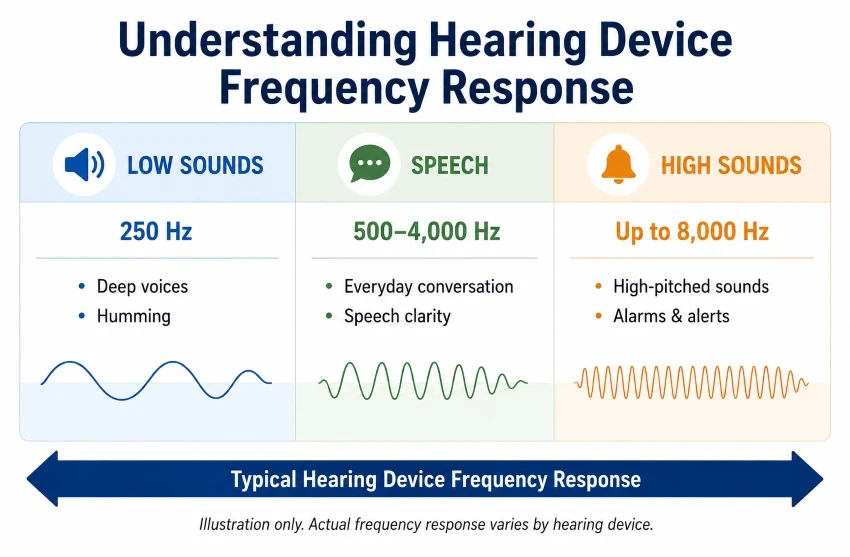
A hearing device with a broader frequency response can capture more sounds, but its overall effectiveness also depends on sound processing, microphone quality, and how well the device fits.
Why Frequency Response Isn’t the Only Specification That Matters
Frequency response is a basic specification, but it doesn’t capture all details. Two hearing aids with the same frequency range can produce very different sound quality due to differences in digital signal processing, microphone quality, and acoustic design.
When assessing hearing aids, consider the full range of features instead of just one specific metric.
Essential Specifications to Compare
In addition to frequency response, consider these important specifications to understand how a device will perform during everyday use:
- Noise Reduction: Filters background chatter and ambient noise to lower listening effort.
- Directional Microphones: Focus on voices directly in front of you while suppressing unwanted sounds from the side and rear.
- Feedback Cancellation: Suppresses high-pitched whistling or squealing caused by sound leaking from the ear canal back into the microphone.
- Bluetooth Connectivity: Enables direct audio streaming and hands-free calls from smartphones, tablets, or TVs.
- Battery Type & Runtime: Compares disposable button cells against rechargeable lithium-ion options based on daily convenience and power needs.
- Ingress Protection (IP Rating): Measures resistance to dust, sweat, and moisture to ensure long-term durability.
Our Senior-Friendly Hearing Devices Usability Checklist highlights practical features that are often as important as technical specs, helping you assess if a device is suitable for daily use.
Maximum Output (OSPL90)
Maximum Output, often referred to as OSPL90 (Output Sound Pressure Level with a 90 dB input), indicates the highest sound level a hearing device can generate in a laboratory environment.
Manufacturers include this specification to set a device’s maximum power limit. It serves as a safety cap, keeping peak output within safe sound levels to safeguard hearing.
Why It Matters
- Protects Against Peak Loudness: Prevents sudden, loud noises such as door slams or car horns from reaching harmful levels in the ear canal.
- Acoustic Fitting Reference: Assists audiologists and hearing specialists in verifying that a device has enough power reserve to support severe or profound hearing loss.
What to Keep in Mind
- Higher Does Not Mean Better: Very high OSPL90 limits may lead to physical discomfort or increase the risk of noise-induced hearing damage if improperly fitted.
- Not a Daily Volume Setting: OSPL90 indicates the utmost laboratory limits and is not encountered during normal conversation or media streaming.
- Prescription-Dependent: Modern digital hearing aids automatically adjust their maximum output according to your audiogram, so even two users with the same model will experience different peak volume limits.
Key Takeaway: OSPL90 specifies the maximum acoustic power as a key technical safety standard. Nonetheless, daily performance relies on factors such as dynamic compression, correctly configured peak-limiting algorithms, and expert custom programming.
Why Maximum Output Shouldn’t Be Your Primary Criteria
Evaluating a hearing device only by its peak output is like judging a car solely on top speed—this overlooks how it performs in everyday use. In real life, factors such as sound clarity, appropriate output limiting, comfort, and ease of control are much more important than simply achieving the highest decibel on a technical specification.
When evaluating hearing devices, prioritize how effectively the technology integrates with your daily activities and physical requirements instead of just considering a single technical limit.
Prioritizing Ease of Use and Everyday Independence
For many adults, a hearing device is among various tools that help maintain daily comfort and independence. Devices that feature intuitive controls, easy tactile feedback, and minimal maintenance can greatly decrease everyday frustration.
The same usability principles also apply to other health and wellness tools created for daily comfort.
- Clear Controls: Easy-to-reach buttons or dials that do not require fine motor precision.
- Ergonomic Handling: Materials and shapes that are simple to insert, adjust, or remove without strain.
- Low-Friction Maintenance: Straightforward battery charging or replacement procedures.
Related Resource: Our guide to the Five Best Hand Massagers for Seniors reviews models for ergonomics, ease of use, and overall value, helping you find user-friendly devices that promote comfort and independence at home.
Full-On Gain (FOG)
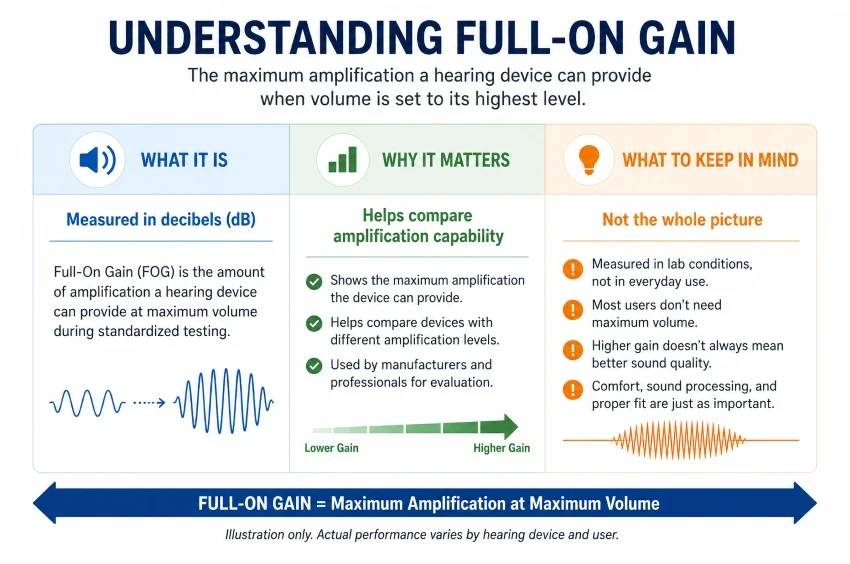
Full-On Gain (FOG) indicates the highest volume increase a hearing device can deliver when set to maximum during lab testing.
Gain, measured in decibels (dB), indicates the precise difference between the incoming sound’s volume and the amplified sound’s volume at the receiver’s output. For instance, if the incoming sound is 50 dB and the device outputs 80 dB, then the gain is 30 dB.
Why It Matters
- Prescription Matching: Verifies if the device provides sufficient power for your level of hearing loss.
- Volume Reserve: Provides additional amplification in case your hearing ability changes over time.
What to Keep in Mind
- Not Daily Volume: Full-On Gain represents a lab maximum, but you’ll wear the device at a much lower, more comfortable setting.
- More Gain vs. Better Clarity: Excessive amplification distorts speech and results in high-pitched whistling (feedback).
- Lab vs. Real Life: Actual volume varies depending on ear canal size, dome fit, and automatic software adjustments.
Number of Channels
Channels separate incoming sound into different frequency bands, enabling a hearing device to process various pitch ranges independently.
For example, a 16-channel device divides audio into more detailed bands than an 8-channel model, allowing for more accurate adjustments tailored to specific hearing loss profiles across low, mid, and high frequencies.
Why It Matters
- Targeted Prescription Tuning: Allows for accurate gain tuning to match complex and uneven hearing loss profiles.
- Granular Noise Suppression: Separates background noise within certain frequency ranges while maintaining speech clarity in other bands.
What to Keep in Mind
- Diminishing Returns: Research indicates that adding more than 12 to 18 channels provides little to no real-world improvement in speech clarity.
- Core Software Matters: Processing algorithms and directional microphones have a much greater influence on speech understanding than simply increasing the number of channels.
- Physical Fit Takes Priority: A well-designed channel setup cannot compensate for a poorly fitted ear dome or an incorrect physical seal.
Key Takeaway: Channel count reflects the device’s ability to segment audio for processing. Although useful for accurate prescription fitting, it should be considered together with noise reduction features, comfort, and professional programming.
The American Speech-Language-Hearing Association (ASHA) notes that hearing devices must be selected and fitted based on individual clinical needs rather than on a single technical specification.
Noise Reduction
Noise reduction employs digital signal processing (DSP) to minimize unwanted background sounds while maintaining speech clarity. Instead of simply amplifying all ambient audio, the device detects and suppresses constant, steady noise, making listening easier.
Modern algorithms continuously analyze incoming sound to differentiate static noises (such as air conditioners, engine hums, or fans) from active human voice patterns.
Why It Matters
- Lowers Listening Fatigue: Lowers mental effort required to ignore background noise in lengthy conversations.
- Improves Signal-to-Noise Ratio (SNR): Reduces ambient rumble, making speech clearer and more distinct.
- Daily Comfort: Reduces sharp, persistent mechanical noises commonly heard in daily settings.
What to Keep in Mind
- Cannot Remove All Noise: Reduces background noise but struggles to isolate voices in highly chaotic environments.
- Over-Processing Risks: Overly aggressive noise filtering may unintentionally soften speech consonants, decreasing overall clarity.
- Synergy Required: Achieves optimal performance only when used with directional beamforming microphones.
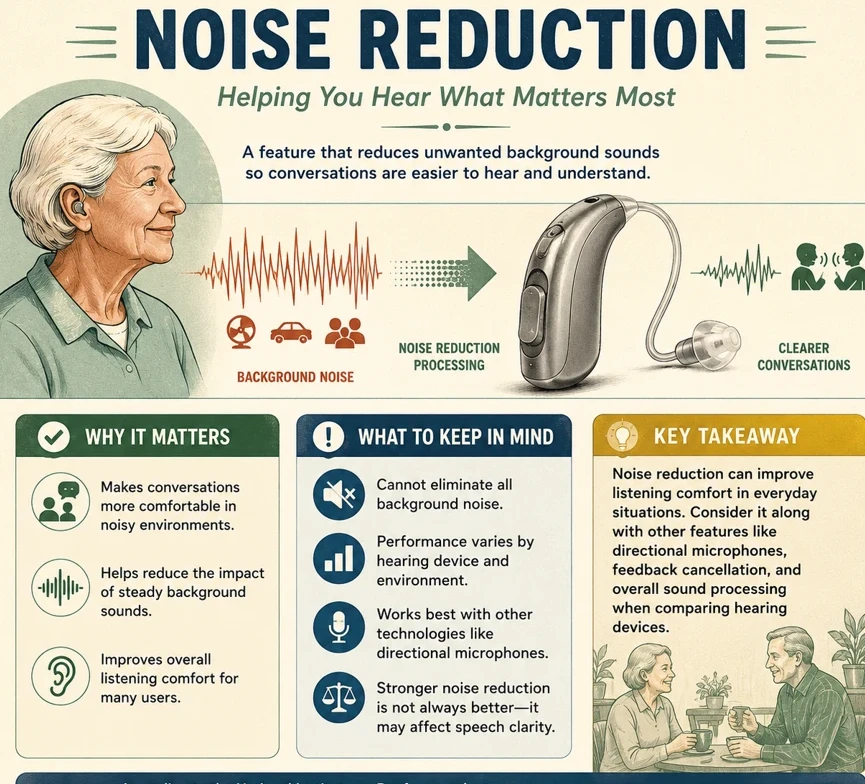
Key Takeaway: Digital noise reduction helps make listening easier in noisy environments. Nonetheless, it depends largely on directional microphones and signal processing to ensure speech remains clear and natural.
You might also find the guide to the 5 Best Compression Foot Massagers for Seniors helpful because it compares models based on features, usability, and value. It’s perfect if you’re looking for a simple wellness device for daily comfort.
Directional Microphones
Directional microphones emphasize sound coming from a particular direction—usually the user’s straight ahead—while reducing noise from the sides and behind.
Most modern hearing aids feature adaptive dual-microphone systems that constantly monitor the environment, seamlessly switching between all-around (omnidirectional) and focused (directional) beamforming modes depending on ambient noise levels.
Why It Matters
- Targeted Speech Isolation: Focuses on enhancing face-to-face voices in lively, noisy settings such as restaurants or social gatherings.
- Reduces Listening Effort: Reduces cognitive fatigue by helping the brain filter out background noise.
- Improves Signal-to-Noise Ratio (SNR): Enhances the target voice volume compared to background noise.
What to Keep in Mind
- Requires Line-of-Sight: Performs at its best when the speaker faces you directly.
- Wind Sensitivity: Dual-port microphones may detect wind turbulence, but advanced software now actively corrects for it.
- Not a Complete Noise Barrier: Greatly reduces background noise, though it cannot fully eliminate sound in chaotic room acoustics.
Key Takeaway: Directional beamforming is highly effective for enhancing speech clarity in noisy environments. Its performance is optimal when combined with digital noise reduction algorithms and appropriate acoustic venting.
Bluetooth Connectivity
Bluetooth connectivity allows hearing devices to connect wirelessly with smartphones, tablets, televisions, and streaming hubs. Instead of needing external neckloops, today’s hearing aids can directly stream phone calls, music, navigation prompts, and TV audio into the receiver.
Protocol support varies across manufacturers, ranging from classic Bluetooth to low-energy protocols, including MFi (Made for iPhone), ASHA (Audio Streaming for Hearing Aids for Android), and the newest Bluetooth LE Audio with Auracast.
Why It Matters
- Direct Speech Clarity: Streams phone calls and media directly to both ears, eliminating room echo and ambient noise.
- Hands-Free Operation: Allows phone calls and voice commands without holding the phone to your ear on supported models.
- App Control: Allows for subtle control of volume, programs, and frequency through a smartphone companion app.
What to Keep in Mind
- Faster Battery Drain: Active audio streaming uses more power, which reduces daily battery life.
- OS & Hardware Compatibility: Device compatibility varies; some support native streaming via Apple (MFi) or Android (ASHA), whereas older phones need a streamer accessory.
- Connection Stability: Bluetooth typically operates within a 30-foot range, but obstacles like barriers or body shielding can sometimes lead to signal dropouts.
Key Takeaway: Bluetooth connectivity greatly enhances daily convenience for phone calls and media streaming. Always ensure that your device’s Bluetooth protocol (MFi, ASHA, or LE Audio) is compatible with your smartphone model prior to buying.
Related Planning Guide: Technology Buying Checklist for Seniors: Questions to ask before buying to compare features, identify daily needs, and make an informed choice.
Rechargeable vs. Disposable Batteries
Battery technology directly influences how you use and manage your device daily. Contemporary hearing aids are equipped with either sealed rechargeable lithium-ion batteries or traditional disposable zinc-air button cells.
Why It Matters
- Daily Maintenance Routine: Indicates if you connect a dock each night or manually replace micro-sized batteries every few days.
- Dexterity Requirements: Affects usability for wearers with arthritis, vision impairments, or limited fine-motor capabilities.
- Power Reserve for Streaming: It directly affects the number of hours the device can stream audio via Bluetooth before the battery runs out.
Rechargeable Batteries (Lithium-Ion)
Pros
- Tactile Simplicity: No small battery doors or tiny tabs to manipulate, perfect for limited finger dexterity.
- All-Day Power: Offers up to 24 hours of use, including streaming, with a single overnight charge.
- Reduced E-Waste: Prevents hundreds of disposable button cells from ending up in landfills throughout the device’s life.
Cons
- Fixed Power Source: You won’t have hearing support until you connect to an outlet if you forget to charge it.
- Long-Term Degradation: Built-in lithium cells gradually lose capacity over time and eventually need professional factory servicing.
Disposable Batteries (Zinc-Air)
Pros
- Instant Power Swaps: Replacing empty cells is quick, no need to wait by a power outlet.
- Travel Flexibility: Easily supplement power with spare battery packs during remote travel or emergencies.
Cons
- Frequent Manual Swaps: Requires replacing tiny cells every 3 to 14 days, depending on battery size (10, 312, 13, or 675).
- Ongoing Expense: Requires ongoing out-of-pocket expenses for new battery multipacks.
Key Takeaway: Rechargeable models provide exceptional convenience for daily household tasks and individuals with dexterity challenges. Meanwhile, disposable batteries are still practical for frequent travelers or users who favor quick battery replacements instead of nightly charging routines.
IP Rating (Water and Dust Resistance)
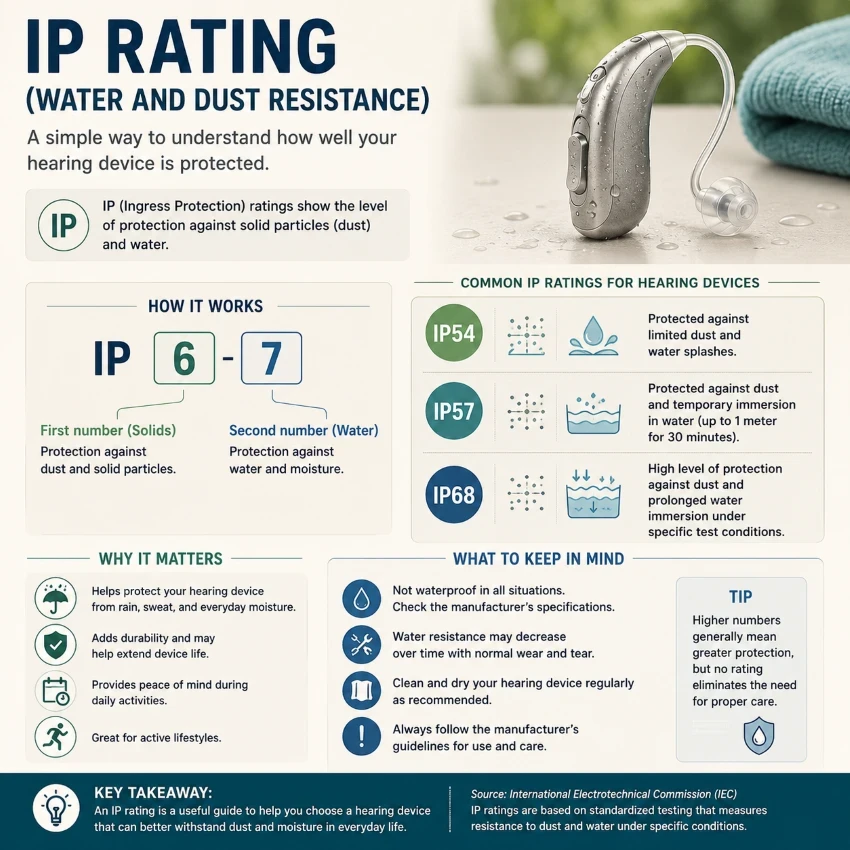
An Ingress Protection (IP) rating indicates how effectively a hearing device’s outer casing resists dust and liquid intrusion.
The rating consists of two numbers:
- First Digit (0–6): Level of protection against solid particles and dust.
- Second Digit (0–8): Level of protection against moisture, sweat, and water immersion.
Common Hearing Aid IP Ratings
- IP54: Provides protection against minimal dust entry and light water splashes from all directions.
- IP57: Provides protection against internal dust accumulation and brief submersion in shallow water.
- IP68: Industry-leading standard providing complete dust-tight protection and continuous freshwater submersion, typically up to 1.5 meters for 30 minutes as per manufacturer specifications.
Why It Matters
- Sweat & Humidity Defense: Prevents skin oils, sweat, and rain from shorting out sensitive internal microphones and processors.
- Extended Hardware Lifespan: Minimizes internal corrosion and reduces the need for frequent repairs caused by moisture damage.
- Daily Reliability: Prevents accidental drops into sinks or from wearing devices during intense exercise.
What to Keep in Mind
- Water-Resistant vs. Waterproof: An IP68 rating does not mean you can swim, shower, or dive while wearing hearing aids.
- Acoustic Ports Remain Vulnerable: Microphones and receivers require open air access to transmit sound, which makes them vulnerable to wax and water blockages.
- Seals Degrade Over Time: Rubber gaskets and water-repellent nano-coatings naturally degrade over time due to daily use, heat exposure, and skin contact.
Key Takeaway: High IP ratings (such as IP68) are crucial for safeguarding against daily sweat, rain, and dust. Nonetheless, regular upkeep—like drying devices, replacing wax guards, and using electronic dehumidifiers—is still essential for ensuring durability over time.
Listening Programs (Memory Settings)
Many hearing devices feature listening programs, which are pre-configured options that adjust how the device processes sound in various settings.
For instance, one program might be tailored for quiet conversations, whereas another is intended for noisier environments.
Why It Matters
- Makes it easier to adapt to different listening environments.
- Can improve comfort without manually adjusting multiple settings.
- Some devices switch programs automatically.
What to Keep in Mind
- The number of programs varies by model.
- Having more programs does not automatically translate to improved performance.
- Some hearing devices enable users to switch programs using a smartphone app.
Key Takeaway: Listening programs enhance convenience by adjusting the hearing device for various situations. While a helpful feature, they should be evaluated alongside sound quality, usability, and other specifications when comparing products.
AI and Smart Features
Modern hearing devices use artificial intelligence (AI) and smart processing to analyze ambient sounds in real time and adjust settings automatically. This eliminates the need for wearers to manually modify volume or switch programs when moving from quiet environments to noisy streets, as embedded machine-learning algorithms perform quick, automatic adjustments.
Why It Matters
- Hands-Free Adaptability: Automatically separates speech from background noise and reduces interference as acoustic settings shift.
- Environmental Learning: Learns personal volume preferences for specific locations and automatically applies them using GPS.
- Health and Safety Tracking: Includes sensor-based features such as fall detection, step counting, and real-time translation on certain premium models.
What to Keep in Mind
- Higher Cost: Advanced machine-learning chips are typically found in mid- to premium-tier hearing devices.
- Battery Demand: Continuous real-time AI processing leads to higher battery drain, so rechargeable models are preferable.
- Not a Professional Substitute: AI algorithms improve everyday convenience; however, accurate prescription fitting still requires a hearing care professional.
Key Takeaway: Smart features reduce the need for manual adjustments, simplifying hearing aid use during busy daily routines. Consider AI tools as supplementary convenience features rather than substitutes for core acoustic performance.
Related Resource: A guide on How Technology Helps Seniors Age in Place, discussing solutions for safety, communication, and daily tasks.
Which Specifications Matter Most?
When comparing hearing devices, not all specifications are equally important. While technical details are useful, some features have a greater impact on daily use than others.
| Specification | Why it Matters |
| Noise Reduction | Helps reduce steady background noise. |
| Directional Microphones | Improves conversations in noisy places. |
| Battery Type | Affects convenience and daily maintenance. |
| IP Rating | Indicates protection against dust and moisture. |
| Frequency Response | Shows the range of sounds the device can process. |
| Listening Programs | Adapts the device to different environments. |
| Bluetooth Connectivity | Enables wireless calls and audio streaming. |
| AI & Smart Features | Automatically adjusts settings in changing situations. |
Key Takeaway: Instead of selecting a hearing device based solely on one feature, evaluate the entire set of features and consider how they align with your daily needs, lifestyle, and usability preferences.
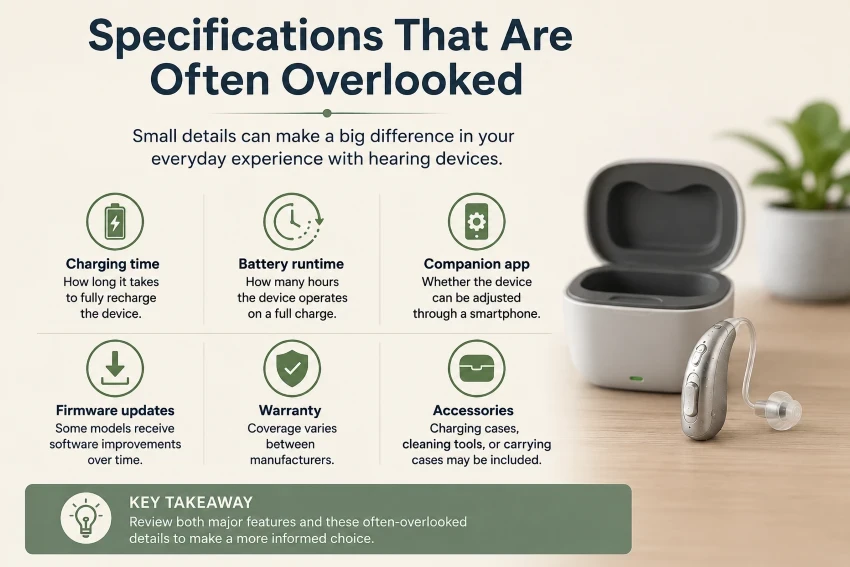
Often Overlooked Specifications
Major features like Bluetooth attract the most attention, but smaller technical details significantly affect daily use and long-term value.
Key Specifications to Check
- Charging Time: Full charges typically take 2 to 4 hours. For quicker options, seek fast chargers that can provide 3 hours of power in just 15 minutes.
- Real Battery Runtime: Check the battery life with Bluetooth enabled. Streaming audio can reduce the battery life by up to 40%.
- Companion App Features: Look for straightforward app controls. Features such as locating lost devices provide additional value.
- Firmware Updates: Wireless updates provide performance improvements without the need to visit a clinic.
- Warranty Coverage: Select plans that include coverage for repair, loss, and accidental damage.
- Included Accessories: Verify that the box contains additional wax guards, cleaning tools, and appropriate dome sizes.
Key Takeaway: Pay attention to small details, as they directly affect daily satisfaction. Before purchasing, review the battery metrics, warranty terms, and included tools.
Hearing Device Specifications Common Misunderstandings
Technical specifications help you compare models, but they can sometimes be misleading. Remember these five common myths.
- More features do not mean better quality. Extra features raise costs. A simple, comfortable fit matters more.
- More channels do not guarantee clearer sound. Extra channels allow finer tuning, but beyond 12 to 18 bands, the brain cannot tell the difference.
- High IP ratings do not make devices waterproof. IP ratings show water resistance in lab tests. Never swim or shower with your device.
- Bluetooth is not required. Streaming is convenient, but many users prefer simpler devices with longer battery life.
- Spec sheets do not tell the full story. Tech specs ignore fit, real-world comfort, and overall reliability.
Key Takeaway: Don’t select a device solely on technical specs. Instead, opt for a model that is comfortable to use, produces a natural sound, and fits into your daily routine.
Frequently Asked Questions
What is the most important specification?
No one specification is most important; instead, consider the balance between noise reduction, microphone design, battery type, and ease of use.
Do more channels mean better hearing?
Channels enable fine-tuning; however, adding extra channels does not necessarily improve sound quality.
Is Bluetooth necessary?
Bluetooth is useful for phone calls and streaming, but it isn’t necessary for everyday hearing support.
Which IP rating should I look for?
Choose IP68 if you sweat a lot or are outdoors. Higher ratings indicate stronger dust and moisture resistance.
Are rechargeable batteries better than disposable ones?
Neither option is universally better. Rechargeable batteries provide everyday convenience, whereas disposable ones are ideal for frequent travelers.
Do technical specs predict real-world performance?
No. Specs compare lab numbers, but they do not assess physical fit, comfort, or speech clarity in actual use.
Final Thoughts
Technical specifications help you compare models, but lab numbers do not account for physical fit or daily comfort.
Consider the entire package rather than just one feature. Prioritize sound clarity, user-friendliness, overall durability, and comprehensive warranty coverage.
Select features that truly align with your daily habits, such as Bluetooth streaming or rechargeable batteries. Focusing on comfort and speech clarity will ensure you have the best experience.