
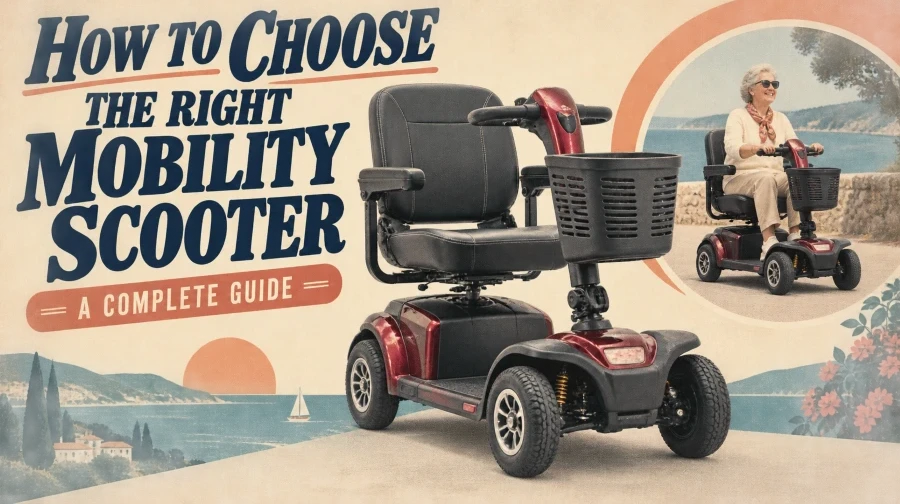
Selecting the right mobility scooter starts with your daily habits. A scooter that’s comfortable outdoors might be too bulky for your hallway or too heavy to lift into a car. Before comparing models, consider where you’ll ride most, how far you typically travel, and where you’ll store and charge the scooter.
This guide outlines the main scooter types and the key features to consider when buying. You’ll learn what to measure at home, what to inspect during a test ride, and the key questions to ask before deciding.
Consider where you will use your mobility scooter
Imagine your typical trips prior to examining different models. The scooter should work well both on your visits and at home.
- Mostly indoors: Measure the width of your narrowest doorway to ensure enough space to turn in hallways and other confined areas.
- Short outdoor trips: Consider pavements, slopes, curbs, and the distance to your frequent destinations.
- Trips by car: Measure the boot. If the scooter folds or disassembles, determine the weight of the heaviest part and identify who will lift it.
- Longer outings: Consider seat comfort, battery range, and where you could charge the scooter.
Also, determine where you will park and charge it at home. Record these measurements and requirements, as they will help you eliminate scooters that don’t fit your routine.
Which mobility scooter fits your routine?
Once you’ve decided on your riding location, evaluate the main scooter types. While the number of wheels is important, also consider the scooter’s size, turning radius, and portability.
Three-wheeled scooters
Three-wheeled scooters typically offer more legroom and better maneuverability for tighter turns. They may suit indoor environments, but test how each model performs on the surfaces you plan to use.
Four-wheel scooters
Four-wheel models typically feature a wider wheelbase, which can make them feel more stable outdoors. However, some may require more space to turn. Compare the actual turning radius, not just the number of wheels.
Folding and dismantling scooters
These are intended for transport. A folding scooter remains intact, while a dismantling scooter comes apart into sections. Before choosing, make sure the scooter—or its heaviest component fits in your vehicle.
Larger outdoor scooters
These scooters provide a more comfortable ride on longer trips but require more space for parking, storage, and turning.
Pride Mobility’s guide to scooter features explains how wheel layout, turning radius, range, and portability affect the choice. Use those points to compare specific models against your route and measurements.
The mobility scooter’s key features
Specifications become more practical when you integrate them into your daily routine. Use this table to compare models suitable for the areas where you plan to ride.
| Feature | What it means | What to check |
| Dimensions | The scooter’s overall length and width | Will it pass through your narrowest doorway and fit where you store it? |
| Turning radius | The space needed to make a full turn | Can it turn in your hallway, lift, or other tight spaces? |
| Weight capacity | The maximum load the scooter is designed to carry | Does it support the rider and the items they usually carry? |
| Battery range | The manufacturer’s estimated distance per charge | Is there enough range for your usual round trip, with room for variation? |
| Seat and tiller adjustment | How the seating position and steering controls can be changed | Can you sit comfortably and reach the controls? |
| Wheels, ground clearance, and suspension | Features that affect how the scooter handles different surfaces | Do they suit your usual pavements, paths, and entrances? |
| Lights and brakes | Features used to see, be seen, and stop | Can you operate them confidently during a test ride? |
| Transport weight | The weight you must lift to load the scooter | If it comes apart, what does the heaviest piece weigh? |
Check out our guide to the top all-terrain electric scooters for adults, including models perfect for seniors, especially if your usual routes involve gravel, grass, or uneven ground.
Helpful Tip: Treat the advertised battery range as an estimate, as actual distance may vary based on rider weight, terrain, battery condition, and other riding conditions.
Can you use and store the scooter easily?
A scooter might look suitable on paper but feel uncomfortable in everyday use. Before you buy, consider how well it suits both the rider and the home environment.
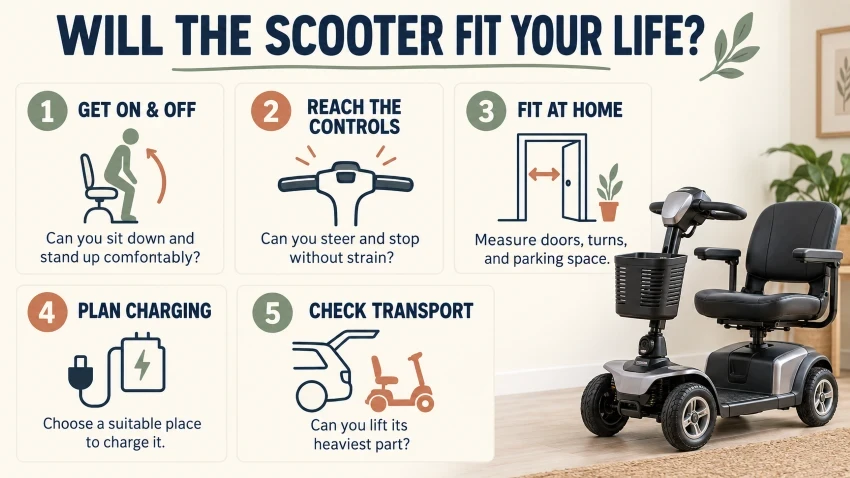
- Getting on and off: Can you reach the seat and stand up comfortably? Try a swivel seat or movable armrests during a test ride.
- Steering and controls: Can you reach the tiller, operate the speed control, and stop without straining your hands?
- Space at home: Is there sufficient space to navigate doors, make turns, and park the scooter?
- Charging: Is there a suitable place to charge it according to the manufacturer’s instructions?
- Transport: Can the person loading it manage the folding process or lift its heaviest section if it needs to be placed in a car?
Helpful tip: Consult a healthcare or mobility expert if you’re unsure about your safety or whether the device provides adequate support.
Key aspects to examine during a test ride
A test ride allows you to identify issues that specifications alone cannot reveal. Ask the seller for ample time to try the scooter without feeling rushed.
- Get on and off: Can you get on and off comfortably, using the seat and armrests?
- Adjust your position: Can you reach the tiller and controls while sitting properly?
- Start, turn, and stop: Start at a gentle speed. Check how easily you can turn in a space similar to your hallway or usual route.
- Check the ride: Does the seat feel comfortable? Can you see where you are going and use the controls without straining?
- Try transport tasks: Ask for a demonstration to confirm whether the scooter folds or disassembles, and have the person who will load it try lifting the heaviest part.
Also ask whether you can test the scooter on an appropriate outdoor surface, especially if you plan to ride outdoors.
Middlesbrough Council’s mobility scooter guidance recommends taking time to assess the controls and comfort, and to determine whether you can get on and off safely.
Useful Tip: Noting what felt easy or difficult after each test ride will help you compare models later, rather than relying on first impressions.
Additional costs beyond the scooter’s initial price
Inquire with the seller about before making a purchase:
- Battery replacement: What kind of battery does the scooter operate on, and how much would a replacement cost?
- Servicing and repairs: Who can service the model locally, and what does the warranty cover?
- Tires and other parts: Are replacement parts accessible, and are they covered by the warranty?
- Delivery and setup: Will someone assemble the scooter and demonstrate how to use and charge it?
- Accessories: Are necessary items like a cover or storage bag included, or are they sold separately?
- Returns: Can you return the scooter after testing it at home? Review the time restrictions and any applicable return fees.
These details will help you compare each model’s total ownership costs beyond the initial purchase price.
Compare portable options in our guide to the five best lightweight folding electric scooters for seniors. Review each model’s folded dimensions and weight capacity before you buy.
Common mobility scooter buying mistakes
Check for these easy-to-miss problems before ordering.
- Choosing by advertised range alone: Ensure the scooter can comfortably cover your typical round trip.
- Ignoring the heaviest piece: A scooter may seem portable, but some parts can still be hard to lift into a car.
- Forgetting to measure: Before choosing a model, check doorways, turning space, storage space, and the car’s trunk.
- Skipping a test ride: A scooter’s controls, seat, and steering may feel different than you expect.
- Assuming “all-terrain” means every surface: Refer to the manufacturer’s instructions regarding slopes, ground clearance, and intended paths.
Taking a few measurements and doing a test ride can help ensure you choose a scooter that looks right online but fits your daily needs.
Quick checklist before you buy
Use this checklist to evaluate your selected scooters. Enter details for each model instead of just relying on the product descriptions.
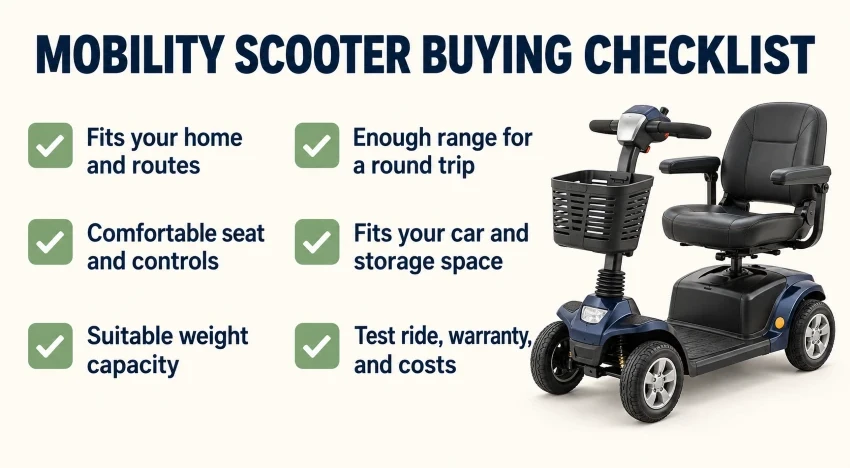
- Daily route: Does it suit the distances and surfaces you typically travel on?
- Home measurements: Will it pass through your doors, navigate turns, and fit into its parking spot?
- Rider fit: Can you get on and off, sit comfortably, and reach the controls?
- Weight capacity: Does it cover you and the items you typically carry?
- Battery range: Is there enough for a round trip with some room to spare?
- Transport: Will it fit in your car? Can the loader lift the heaviest item?
- Charging: Is there an appropriate place to charge it as instructed?
- Test ride: Have you experimented with starting, turning, stopping, and adjusting the seat?
- Total cost: Have you verified the delivery, batteries, servicing, warranty, and return policies?
Useful Tip: Keep your measurements and notes nearby this list. If the scooter fails an essential check, consider a model that better fits your routine.
Frequently asked questions
Which is better, a three- or four-wheel mobility scooter?
Your choice depends on where you ride. Some three-wheel models offer tighter turns, whereas four-wheel models usually have a wider wheelbase. Compare their turning radii and test both types before deciding.
How much battery range do I require?
Start with the length of your usual round trip, then add some extra range. Keep in mind that range on a single charge can vary depending on terrain, rider weight, and battery health.
Can a mobility scooter pass through my doorway?
Measure the narrowest doorway the scooter needs to pass through and compare it with the model’s specified width. Additionally, verify the available turning space on both sides of the door.
What does “heaviest piece” mean?
The heaviest piece is the largest part you need to lift after dismantling a scooter. Use this figure to determine if it will fit in a car, as the total scooter weight alone doesn’t indicate whether it can be loaded.
Should I opt for a folding or dismantling scooter?
Choose the option that fits your transportation needs. A folding scooter remains intact, while a dismantling model comes apart into sections. Test the process to see what the person loading it can handle.
Can I purchase a scooter without a test ride?
You can proceed, but the most effective way to evaluate the seat, controls, steering, and ease of getting on and off is through a test ride. If you can’t test the model beforehand, confirm the return policy in writing before ordering.
Check out the review of the Drive Medical Phoenix LT 4-Wheel Mobility Scooter to see how these features integrate into a single model.
Final thoughts
Choose the ideal mobility scooter by considering your typical riding locations, then compare factors such as size, turning radius, comfort, battery life, and transport weight.
Bring your measurements to a seller and, if possible, test the scooter before purchasing. A model that is easy to control and suits your daily environment is a smarter choice than one with impressive specs you’ll seldom use.